
513.找树左下角的值
题目链接:513.找树左下角的值
文档讲解:代码随想录
状态:层递法AC,递归法没弄清思路
思路
二叉树题目要抓住题干本质->求最后一层最左侧的元素,很显然用层递法轻松适配。
递归呢?思路:最后一层->深度最大的时候赋值;最左侧->首次深度最大的时候赋值。
深度的判断很简单,本质的判断在于第一次到达该深度的时候取值:
第一种思路:使用全局变量保存当前深度,一但有更大就更新,并取值
第二种思路:使用灵神的vector大法,各个递归函数共同维护一个vector数组,其长度起到了全局变量的作用
通过该题了解了在类中写全局变量其实本质就是普通的全局变量,不要糊涂!
题解
class Solution {
public:
    int max_depth = 0;
    int result ;
    // void sovler(TreeNode *root,int depth)
    // {
    //     if(root == nullptr)return ;
    //     if(depth>max_depth)
    //     {
    //         max_depth = depth;
    //         result = root->val;
    //     }
    //     sovler(root->left,depth+1);
    //     sovler(root->right,depth+1);
    // }


    //递归还可以这样写
    // void sovler(TreeNode *root,int depth,vector<int> &res)
    // {
    //     if(root == nullptr)return ;
    //     if(depth>res.size())
    //     {
    //         res.push_back(root->val);
    //     }
    //     sovler(root->left,depth+1,res);
    //     sovler(root->right,depth+1,res);
    // }
    int findBottomLeftValue(TreeNode* root) {
        // sovler(root,1);
        // return result;
        queue<TreeNode*> que;
        int result;
        que.push(root);
        while(!que.empty())
        {
            result = que.front()->val;
            int size = que.size();
            while(size--)
            {
                if(que.front()->left!=nullptr)que.push(que.front()->left);
                if(que.front()->right!=nullptr)que.push(que.front()->right);
                que.pop();
            }
        }
        return result;
    }
};
112.路径总和、113.路径总和ii
题目链接:112.路径总和 113.路径总和ii
文档讲解:代码随想录
状态:Ⅰ轻松AC,Ⅱ在语法上面出现了一些错误
思路
路径总和:简单的加和与递归问题
路径总和Ⅱ:递归还是那个递归,简单的加和变成了稍稍微复杂的字符串vector<vector<int>>处理,本题纠结的点在于,我想设置全局变量res,这样就可以不用res.push_back(vec),而直接使用auto &遍历修改即可。
!!!关键点来了(临时对象的生命周期):
在 C++ 中,临时对象的生命周期通常在表达式结束时结束。例如:
vector<int> getVector() {
    return {1, 2, 3};
}
for (auto &i : getVector()) {
    i = 10;
}
在这个例子中,getVector() 返回的是一个临时的 vector<int> 对象。for 循环中的 auto &i 绑定到这个临时对象的元素上。然而,当 for 循环结束后,这个临时对象会被销毁,因此对 i 的修改不会影响任何持久的变量。
对于本题,函数内虽然return全局变量res,但是对于返回值来说是一个临时变量,所以要遍历并且重新写入res才可!
题解
//路径总和
class Solution {
public:
    bool hasPathSum(TreeNode* root, int targetSum) {
        if(root == nullptr)return false;
        if(root->left == nullptr && root->right == nullptr && targetSum == root->val)return true;
        return hasPathSum(root->left,targetSum-root->val)||hasPathSum(root->right,targetSum-root->val);

    }
};
//路径总和Ⅱ
class Solution {
public:
    vector<vector<int>> pathSum(TreeNode* root, int targetSum) {
        vector<int> vec;
        vector<vector<int>> res;
        if(root == nullptr)return res;
        if(root->left == nullptr && root->right == nullptr && targetSum == root->val)
        {
            vec.push_back(root->val);
            res.push_back(vec);
        }

        for(auto &i:pathSum(root->left,targetSum-root->val))
        {
            i.insert(i.begin(),root->val);
            res.push_back(i);
        }
        for(auto &i:pathSum(root->right,targetSum-root->val))
        {
            i.insert(i.begin(),root->val);
            res.push_back(i);
        }
        return res;
    }
};
106.从中序与后序遍历序列构造二叉树
题目链接:106.从中序与后序遍历序列构造二叉树 105.从前序与中序遍历序列构造二叉树
文档讲解:代码随想录
状态:不会,重新理清树的构造方法(也是递归)
思路
先动手搞明白如何通过中序+前/后序递归构造树:
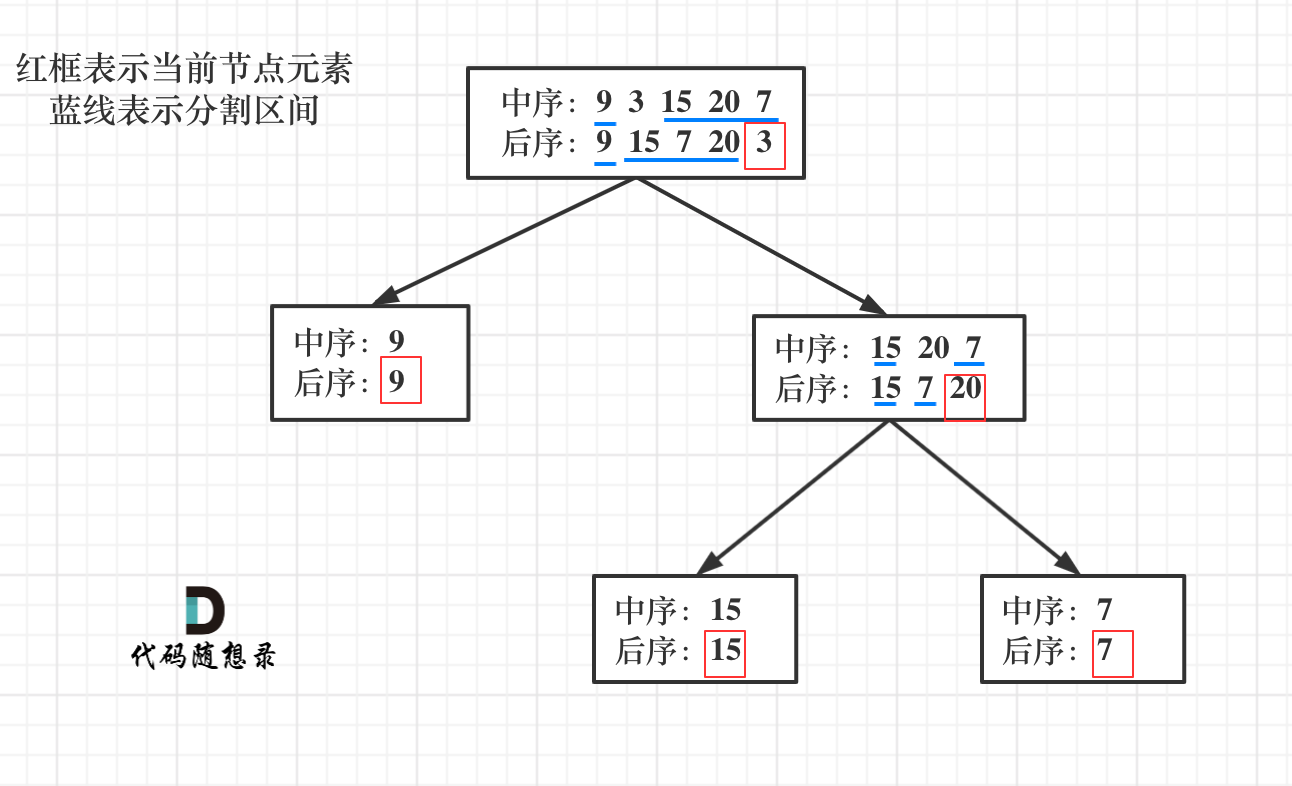
肢解:
-
第一步: 如果数组大小为零的话,说明是空节点了。
-
第二步: 如果不为空,那么取后序数组最后一个元素作为节点元素。
-
第三步: 找到后序数组最后一个元素在中序数组的位置,作为切割点
-
第四步: 切割中序数组,切成中序左数组和中序右数组 (顺序别搞反了,一定是先切中序数组)
-
第五步: 切割后序数组,切成后序左数组和后序右数组
-
第六步: 递归处理左区间和右区间
本题知识点,当用迭代器构造vector时切记区间左闭右开,因为.end()指向数组后一个位置
题解
class Solution {
public:
    TreeNode* buildTree(vector<int>& inorder, vector<int>& postorder) {
        //判断后续是否为空
        //不为空取最后为中间节点
        //在中序中以中间节点分割
        //根据中序分割后续
        //传入函数
        if(postorder.size() == 0)return nullptr;
        TreeNode* mid_node = new TreeNode(postorder[postorder.size()-1]);
        int index = 0;
        for(int i = 0;i<inorder.size();i++)
        {
            if(inorder[i] == mid_node->val)
            {
                index = i;
                break;
            }
        }
        //切割中序
        vector<int> mid_left(inorder.begin(),inorder.begin()+index);
        vector<int> mid_right(inorder.begin()+index+1,inorder.end());
        //切割后序
        vector<int> back_left(postorder.begin(),postorder.begin()+mid_left.size());
        vector<int> back_right(postorder.begin()+mid_left.size(),postorder.end()-1);

        mid_node->left = buildTree(mid_left, back_left);
        mid_node->right = buildTree(mid_right, back_right);
        return mid_node;
    }
};